GS1 Sunrise 2027: What the Barcode-to-QR Code Transition Means for You
 By Kelly Or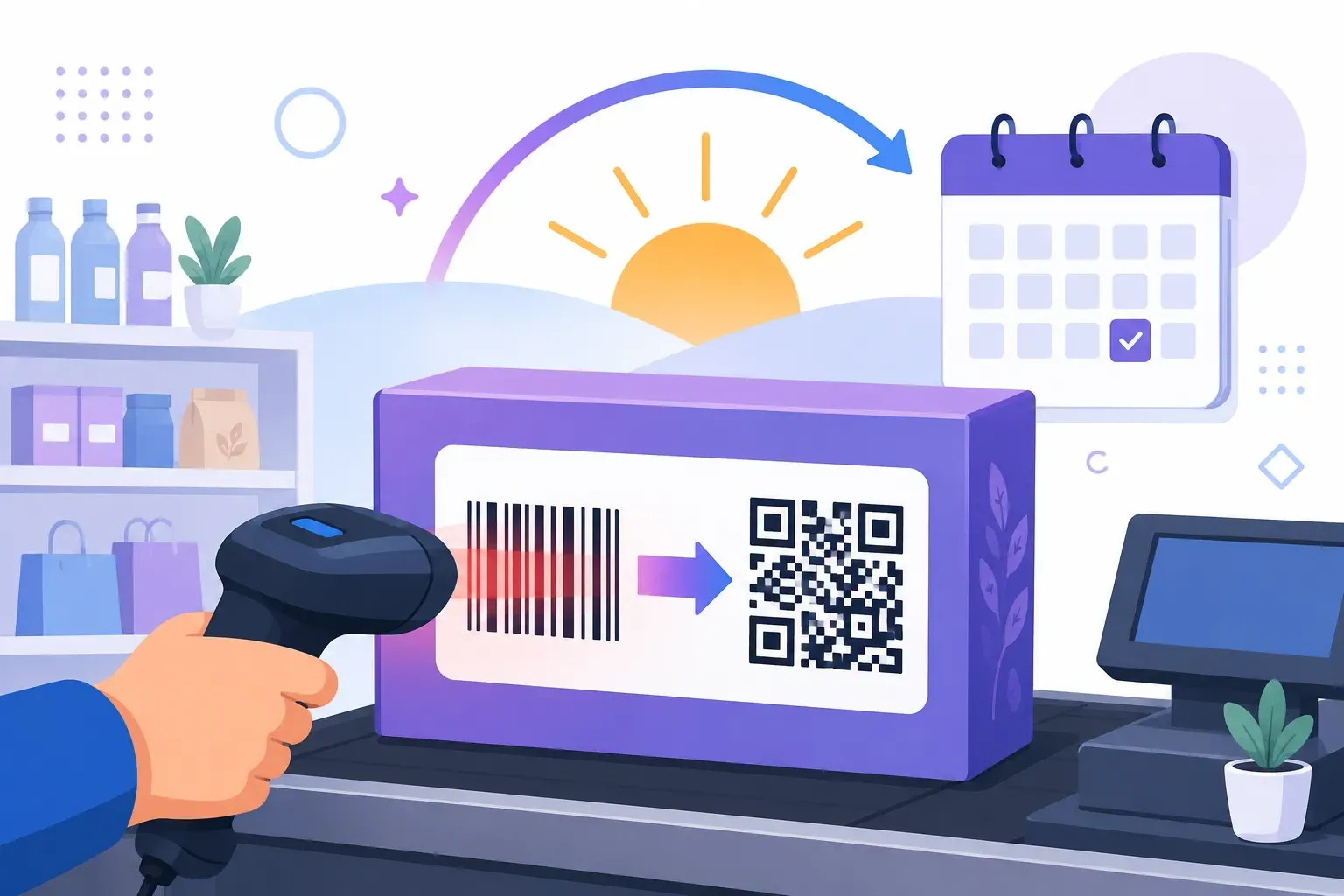
On June 26, 1974, a cashier in Troy, Ohio scanned a pack of Wrigley’s gum and rang up the first retail barcode sale. Fifty years later, barcodes get scanned more than 10 billion times a day, according to GS1 US — and it’s finally being asked to share the checkout lane. GS1 Sunrise 2027 is the retail industry’s coordinated push for point-of-sale systems worldwide to read 2D codes, including QR codes, alongside the traditional stripes by the end of 2027.
Read that carefully: alongside, not instead of, and industry target, not law. A lot of coverage overstates both. This explainer covers what Sunrise 2027 actually commits the industry to, why the shift is happening, the realistic timeline, and what brands and retailers should be doing about it right now.
What Is GS1 Sunrise 2027?
GS1 is the not-for-profit standards organization behind the barcode itself — the body that issues the GTIN product numbers encoded in every UPC and EAN, through member organizations in more than 100 countries. When GS1 coordinates a change, the world’s supply chains eventually follow, because retailers, manufacturers, and logistics systems all speak its standards.
Sunrise 2027 (GS1’s global guideline calls it “Ambition 2027”) is the industry goal that by the end of 2027, retail point-of-sale scanning should be able to read and process the GTIN from 2D barcodes as well as from today’s linear ones. According to GS1’s 2D Barcodes at Retail Point-of-Sale Implementation Guideline (May 2024), the 2D options are a GS1 DataMatrix, or a QR code or Data Matrix using GS1 Digital Link URI syntax. An ordinary QR code with a marketing link isn’t one of them. The name follows precedent: “Sunrise 2005” was the earlier initiative that pushed North American retailers to accept the 13-digit EAN alongside the 12-digit UPC, and it worked.
Three clarifications keep this honest:
- It’s a readiness target, not a mandate. No law requires compliance, and no one’s barcode stops working on January 1, 2028. It’s a migration coordinated across the industry, with a group of major global brands and retailers publicly backing the 2D ambition.
- The 1D barcode isn’t being switched off. The transition period involves “dual marking” — packages carrying both a traditional barcode and a 2D code — and it will last years.
- “2D” means more than QR, and not every QR counts. GS1 DataMatrix already dominates pharma packaging. The QR code (standardized as ISO/IEC 18004) is the format headed for consumer-facing retail because smartphones read it natively. For checkout, though, it must carry your GS1-issued GTIN in GS1 syntax. A QR code that just links to your website doesn’t give the register anything to ring up.
Why Retail Is Moving to QR Codes
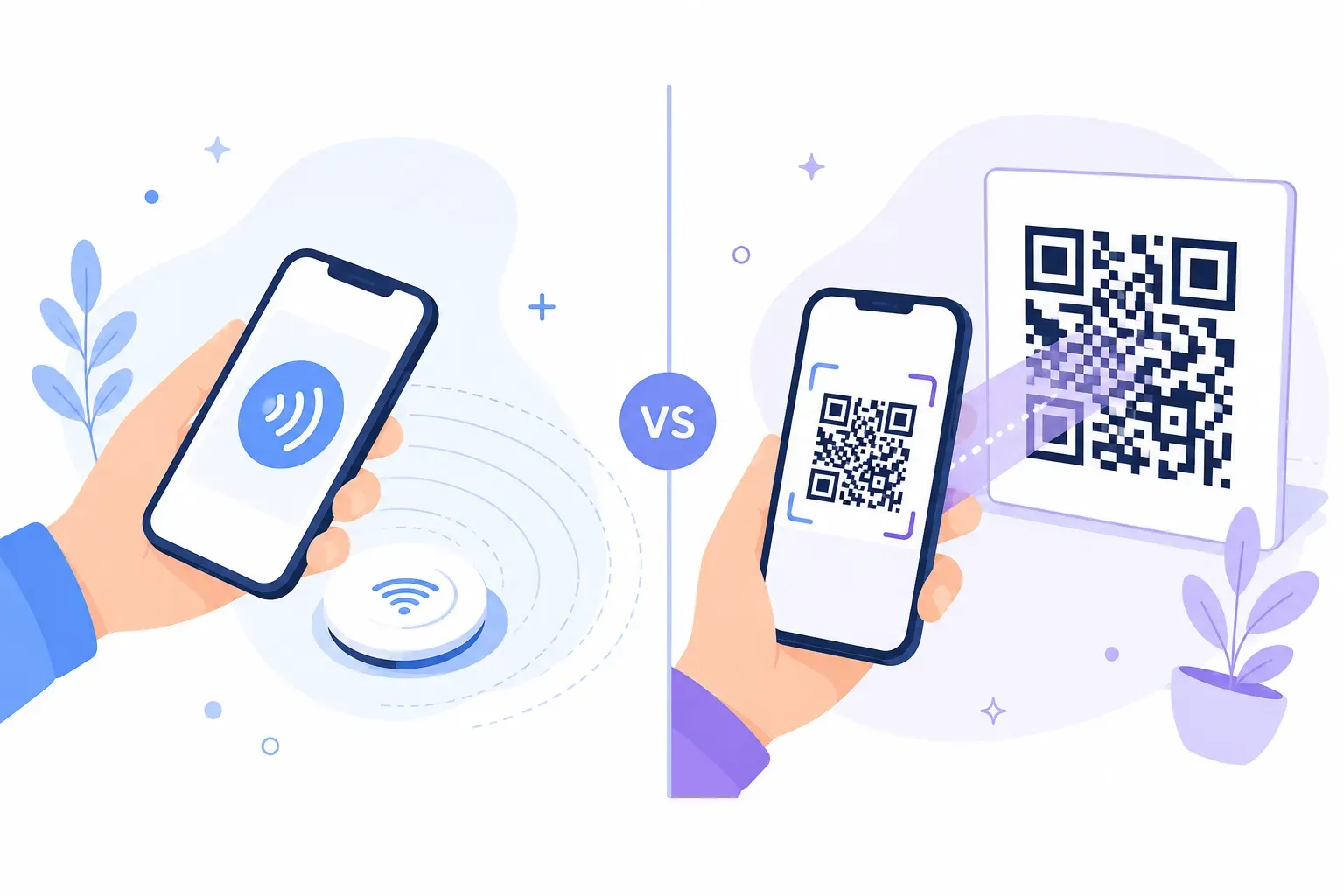
A UPC barcode answers exactly one question: which product is this? Its 12 digits encode the GTIN and nothing else — no batch, no expiry date, no serial number, no link. That was a brilliant trade-off for 1974 laser scanners and a crippling one for 2026 supply chains, which is the entire case for the switch. For the full technical breakdown of the two formats, see our comparison of QR codes vs barcodes.
A 2D code carries the GTIN plus structured extra fields — batch/lot, expiration date, serial number, weight — in a fraction of the space. That unlocks capabilities 1D physically can’t deliver:
- Expiry-aware checkout. The register can flag or block an expired product at scan time, or apply automatic markdowns as dates approach — a direct attack on retail food waste.
- Surgical recalls. With lot numbers readable at every scan point, a recall pulls the affected batches instead of an entire product line off every shelf.
- Serialized authenticity. Item-level serial numbers make counterfeits detectable at the register, not just in the lab.
- One code instead of five. Packaging currently juggles a UPC, a QR for marketing, and sometimes separate codes for loyalty or recycling info. A single 2D symbol can do all of it.
The consumer-engagement half runs through GS1 Digital Link, a standard that formats the product identifier as a working web address — for example, https://id.yourbrand.com/01/09506000134352, where 01 is the application identifier for a GTIN. A POS scanner that supports it extracts the GTIN from that URL and rings up the sale; a shopper’s phone opens it as a normal link and lands on a product page. Same printed square, two entirely different jobs. The GTIN has to be one your company licensed from GS1, and the URI has to follow the GS1 Digital Link standard. That’s what separates a POS-ready code from any other QR code with a link in it.
A marketing QR code is not a POS-ready GS1 code
This is the point most coverage skips. Any QR generator, QRocket included, can turn a URL into a valid QR symbol. That doesn’t make it a retail barcode. A code the register can use needs four things:
- A real GTIN licensed from GS1, the same number that’s in your UPC/EAN.
- Correct GS1 Digital Link syntax (for example
/01/followed by the 14-digit GTIN, plus any batch or expiry qualifiers), which a GS1 Digital Link toolkit or your packaging software should validate. - Print quality that passes verification. GS1 bases barcode quality on ISO/IEC specifications and the GS1 General Specifications, and “highly recommends” verification with a barcode verifier. It also notes that verification doesn’t check where the code sends people online. You have to test that part separately.
- Testing with your retail partners on their actual scanners, including self-checkout cameras, before a production print run.
QRocket renders whatever URL you type into it. It doesn’t issue or check GTINs, validate Digital Link syntax, or grade print quality, so it can’t certify packaging for checkout. Use it for consumer-facing codes such as recipes, manuals and campaign pages. For codes the register must read, follow GS1 US’s Sunrise 2027 resources or your local GS1 member organization.
GS1 Sunrise 2027 Timeline and Key Milestones
The transition has been running longer than most people realize. Retailer pilots with dual-marked packaging began in the early 2020s across markets including the US, Brazil, and Australia, and GS1 formalized the global 2027 ambition after those pilots showed POS systems could handle 2D at checkout speed.
The practical timeline looks like this:
| Period | Milestone |
|---|---|
| 2021–2024 | Global pilots of 2D at point-of-sale; GS1 publishes the Sunrise 2027 ambition and migration guidance |
| 2025–2026 | Scanner and POS software upgrades roll out; brands begin dual-marking packaging (1D + 2D together) |
| End of 2027 | Target date: retail POS systems worldwide capable of scanning and processing 2D barcodes |
| 2028 and beyond | Gradual shift of packaging to 2D-first; 1D barcodes phase down category by category, over years |
Will barcodes disappear after 2027? Not close. The installed base of 1D-only systems — think small shops, vending, legacy warehouse gear — guarantees a long tail, and GS1’s own guidance assumes dual marking well past the target date. What changes in 2027 is the default assumption: from that point, a brand can put a single QR code on new packaging and expect major retail checkouts to handle it.
The direction of travel also lines up with regulation elsewhere. The EU’s Digital Product Passport rules, arriving for batteries and textiles in the late 2020s, require exactly the kind of data-rich, scannable product identity that GS1 Digital Link provides — so the retail migration and the regulatory one reinforce each other.
What Brands Need to Do Now
If your products carry a UPC or EAN today, Sunrise 2027 lands on your packaging eventually. The preparation is unglamorous but concrete:
- Audit your product data. A 2D code exposes batch, expiry, and per-item detail — which means your GTIN records, product attributes, and lot data need to be accurate and centrally managed before they’re printed on everything.
- Choose your 2D format. Consumer-facing categories are converging on QR codes with GS1 Digital Link; regulated categories like pharmaceuticals stay on GS1 DataMatrix. Your retail partners’ guidance decides this, not preference.
- Put Digital Link URLs on a domain you control. The URL inside the code is permanent once printed. Hosting it on your own domain (
id.yourbrand.com) means you can change what shoppers see — ingredients, sustainability data, promotions — without ever reprinting packaging. The path still has to follow GS1 Digital Link syntax with your real GTIN. According to GS1’s guideline, switching from a general URL to Digital Link syntax can also change the code’s size, because the data structure changes. - Plan the packaging real estate. Dual marking means two symbols per pack for several years — the 2D code plus a print-ready UPC or EAN. GS1’s general specifications set minimum sizes and quiet zones for POS scanning, so involve your print supplier early and test scans from real proofs.
- Pilot on one SKU line. Every early adopter’s lesson: run one product through design, print, retailer scan testing, and consumer scanning before touching the full catalog. If that catalog is large, generating codes programmatically matters — our guide to bulk QR code generation from CSV covers the batch workflow.
The marketing side needs no waiting period at all. A standard QR code linking to a product page works on packaging today as a consumer-engagement code, next to your existing UPC/EAN. It won’t be scanned at checkout, and it doesn’t replace the GS1 steps above. It does give your team practice with design, print QA and analytics before the POS-grade codes arrive.
Need a consumer-facing QR code for a recipe, manual or campaign page? Create one free. — Create Your Free QR Code
What Retailers Need to Prepare
Retailers own the harder half of the migration: the scan infrastructure. The good news is that most of the hardware problem has quietly solved itself — modern checkout scanners are camera-based area imagers, and most units shipped in recent years already read 2D symbols. The real work is in software and process:
- POS software upgrades. The register must parse GS1 application identifiers out of a QR code or Digital Link URL — extracting the GTIN for pricing, and ideally using the expiry and lot data rather than discarding it.
- Symbol precedence rules. During dual marking, a package shows two codes. The POS needs a rule for which one wins, and cashiers need to not care — the scan should just work.
- Lane-speed testing. Checkout tolerates roughly zero added seconds per item. 2D scanning at speed is proven in pilots, but every chain should verify it on its own lanes and self-checkout cameras before committing.
- Back-of-store alignment. Receiving, inventory, and shrink systems read barcodes too. A migration plan that stops at the front registers leaves the warehouse scanning stripes forever.
For grocers and big-box chains this is a genuine program of work. For a small shop using a tablet POS, it may be a software update — one worth confirming with your vendor this year. A useful first step either way is an audit: scan a 2D-marked product (any serialized pharmacy package will do) at each register type and note what the system actually captures. Retail teams already using QR codes for engagement have a head start; our guide to QR codes for retail covers that customer-facing layer.
Consumer Benefits
Shoppers won’t read a GS1 standards document, but they’ll feel the results at the shelf. Picture the grocery run of 2028: the QR code on a yogurt cup rings up the sale, and the identical code — scanned with a phone in the aisle — shows the farm cooperative that supplied the milk, confirms the lot isn’t part of any recall, and knocks 30% off because the register knows the expiry date is three days out. One printed square, three different jobs.
That’s the pattern across categories. The same code the register scans becomes, on a phone, the product’s front door:
- Full transparency — complete ingredient and allergen data, sourcing, and certifications, beyond what fits on the label.
- Freshness and safety — expiry-aware pricing in stores, and the ability to check whether a specific lot was recalled from your own kitchen.
- Authenticity — a serialized code that verifies the product in your hand is genuine.
- Sustainability data — recycling instructions and environmental footprint tied to the actual item, the same mechanism the EU’s Digital Product Passport formalizes.
Shopper behavior is ready for this. Scanning became an unremarkable daily habit years ago — our roundup of QR code statistics collects the adoption figures — so the checkout migration meets consumers where they already are.
The Checkout Is the Last Domino
The interesting thing about GS1 Sunrise 2027 is what it removes: the last reason product packaging needed two kinds of codes. Marketing went QR years ago; now the register is following. The practical move for any product business is to stop treating the QR code as a campaign asset and start treating it as product infrastructure — a permanent, data-rich address printed on everything you sell. Codes you design now, on a domain you control and with GS1 Digital Link syntax and a real GTIN, are the ones that survive the transition. Build those with GS1’s tools and guidance, and verify them with your print supplier and retailers. For the consumer-side codes that live alongside them, such as recipes, manuals and campaign pages, QRocket’s free generator produces vector SVG codes with no expiry.
Create a free QR code with custom colors, your logo and print-ready downloads — no sign-up.