NFC vs QR Codes: Which Should You Use in 2026?
 By Kelly Or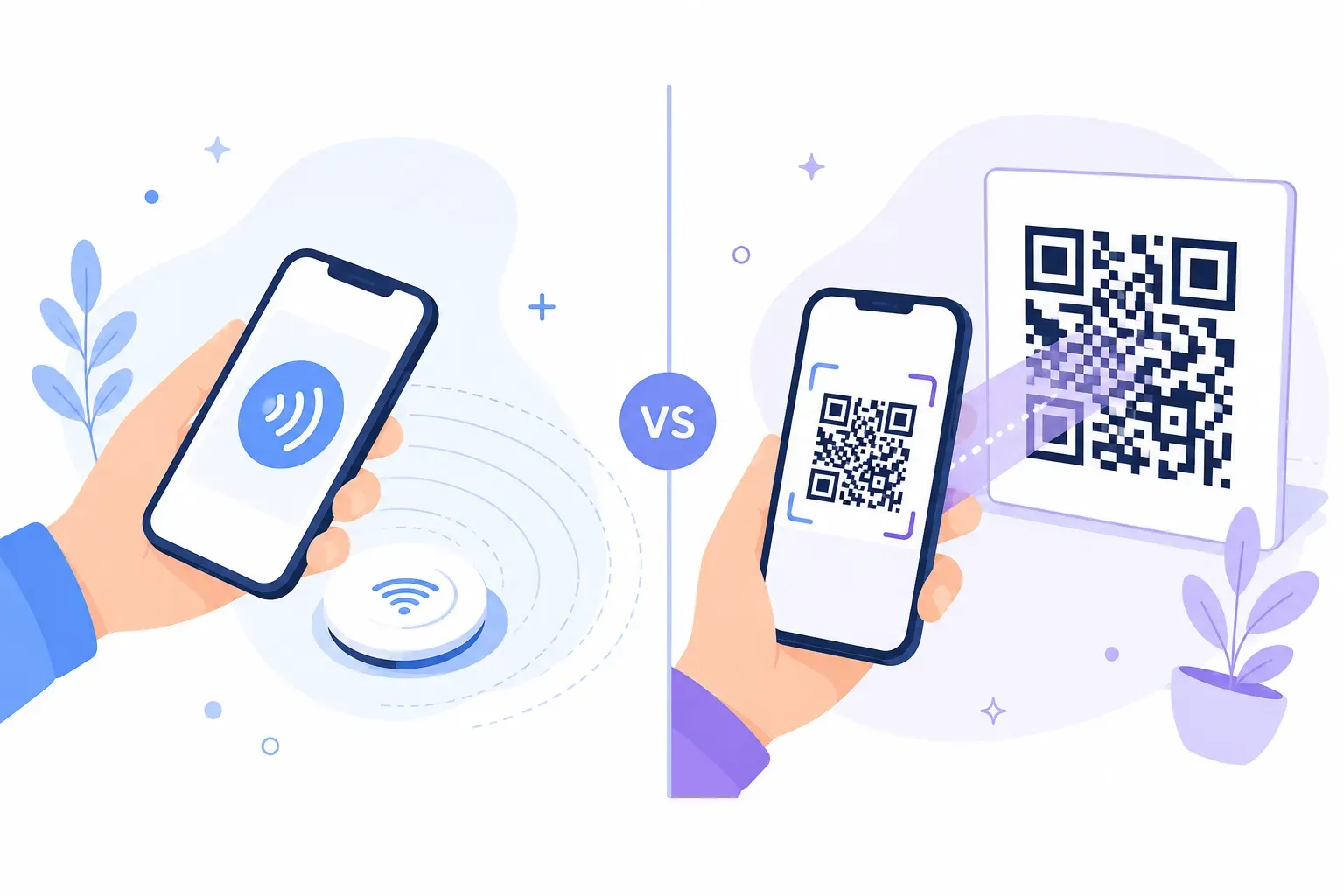
You’re ordering new business cards, or specing smart packaging, and the vendor asks a question you didn’t expect: printed QR code, embedded NFC chip, or both? The NFC vs QR code decision looks like a tech preference but is really an economics-and-context problem. Here’s the short version up front: QR wins on cost, reach, and universality — it’s free ink that works from centimeters or meters away on any phone. NFC wins on experience — a tap feels premium, works in the dark, and does a few things a printed square genuinely can’t. This comparison covers how each works, where the real differences are, and a decision framework for picking (or combining) them.
How NFC and QR Codes Work
NFC — near-field communication — is short-range radio. A passive NFC tag is a coil antenna and a tiny chip, with no battery: when a phone comes within about 4 cm, the phone’s own radio field powers the chip, which transmits its stored content back (the underlying standard is ISO/IEC 14443, operating at 13.56 MHz). That content is usually a URL, and the phone pops a notification to open it. Common tags store between 144 and 888 usable bytes depending on the chip.
A QR code is optical. The pattern encodes data as light and dark modules; the phone’s camera photographs and decodes it — a format invented by Denso Wave in 1994 that holds up to 2,953 bytes. It’s ink or pixels, which means it can exist anywhere an image can. (For how QR differs from its one-dimensional ancestor, see our comparison of QR codes vs barcodes.)
Both technologies end at the same place: a phone opens your link. The entire difference is the journey — radio through proximity versus light through a camera — and that one distinction drives every trade-off below.
NFC vs QR Code: Key Differences in Cost, Access, and Deployment
The tap-vs-scan marketing decision usually comes down to six practical rows:
| Factor | QR code | NFC tag |
|---|---|---|
| Cost per unit | Effectively free — it’s ink | Roughly $0.10–$2 per tag, by chip and volume |
| Working range | Centimeters to many meters (a code scans from ~10× its width) | About 4 cm — physical tap |
| Where it can live | Any printed or digital surface: paper, packaging, TV screens, websites, email | Physical objects only — a chip can’t appear on a screen |
| Phone support | Any camera phone (native since iOS 11 in 2017, Android 10 in 2019) | NFC phones; iPhones read tags in the background since the XS in 2018 |
| Data capacity | Up to 2,953 bytes | Typically 144–888 bytes |
| Updating content | Reprint, or use a dynamic redirect | Rewritable tags can be re-encoded in place |
| Visibility | Self-announcing — people see and recognize it | Invisible — needs a printed “tap here” prompt |
| Durability | Print can fade, tear, or be covered | Sealed chip shrugs off weather and abrasion |
Deployment speed follows from the table. A QR campaign goes from idea to printed flyer the same afternoon; an NFC rollout means ordering tags, encoding each one, and physically attaching them. And the economics diverge fast at volume: putting a code on 10,000 flyers costs nothing extra, while chipping the same run starts around a thousand dollars before labor.
When QR Codes Are the Better Choice
For most campaigns, the printed square wins on four fronts:
- Scale and budget. Zero marginal cost means the technology never limits the print run. This is why menus, flyers, receipts, and product inserts default to QR.
- Distance and screens. A poster across a room, a code in a TV spot, a slide at a conference, a link in an email — all scannable, none tappable. NFC cannot exist in digital or at-a-distance placements at all, and that rules it out of a huge share of real marketing surfaces.
- Universal, learned behavior. Every smartphone camera reads QR natively, and the pandemic years turned scanning into a reflex — global scan volumes have climbed every year since, as our roundup of QR code statistics shows. Nobody needs the affordance explained: the square itself says “scan me.”
- Instant, disposable deployment. A weekend promotion, an A/B test, a lost-dog poster: print now, recycle later. No hardware to recover.
There’s also a subtler advantage: the code is visible, so people choose to engage. An NFC tag needs printed instructions anyway — at which point many designers ask why the instructions aren’t just a QR code.
Start with the technology that scales — create free QR codes with QRocket — Create Your Free QR Code →
When NFC Makes Sense
An honest comparison has to say it plainly: there are jobs where NFC is simply better.
- The premium moment. A tap is theater. On an NFC business card, handing someone your details becomes a single touch — no aiming, no framing — and the gesture itself signals polish. (A printed square does the same job for a fraction of the cost, as our guide to QR codes on business cards shows, but it doesn’t get the same “whoa.”)
- No camera, no light needed. Taps work in a dark venue, through a gloved fumble, for users who struggle with camera focus. There’s no pointing step to get wrong.
- Invisible integration. A chip hides under a label, inside a product, or beneath a table surface — zero design compromise on luxury packaging where a data matrix would fight the aesthetic.
- Outdoor durability and tamper resistance. Sealed chips don’t fade in sunlight or wear off with handling. And while a QR sticker can be maliciously papered over with a lookalike in seconds, a locked NFC tag can’t be re-encoded — replacing it means physically prying hardware off.
- Update-in-place. Rewritable tags let you change the destination without touching the object — the same problem dynamic codes solve in the QR world, as covered in our guide to static vs dynamic QR codes.
- Real authentication. Advanced chips (like NXP’s NTAG 424 DNA family) generate a fresh cryptographic code on every tap, letting brands verify a product is genuine. A QR code can’t do this: a photocopy of a QR code is a perfect QR code, but a copy of an authentication chip isn’t a chip.
The pattern across all six: NFC earns its cost when the object is durable, valuable, or reused — a card handed out for a year, a machine serviced monthly, a handbag worth authenticating. It rarely earns it on paper.
NFC vs QR Codes: A Decision Framework for Marketers and Operators
Four questions settle nearly every case:
- What’s the budget per touchpoint? Under about $0.10 per unit, or thousands of units — QR, no discussion. A short run of high-value objects — NFC is affordable.
- How far away is the user? Anything beyond arm’s reach, or any screen-based placement, is QR by physics.
- What should the moment feel like? Functional (menu, form, manual) — QR. Premium or effortless (VIP pass, flagship packaging, personal introduction) — NFC’s tap earns its price.
- Will the content change? Frequent updates favor a rewritable tag or a dynamic QR redirect; permanent content suits a plain static code, which never expires and depends on no service.
And the framework has a fifth answer most offline tech comparisons skip: both. A card or hangtag with an embedded chip and a printed code covers every phone, every distance, and both interaction styles — tap if you’re close and curious, scan if you’re not. Brands running this combination give up nothing except a few square centimeters of layout. Since the QR half costs nothing to produce, there’s no reason to launch without it: QRocket generates the printed side in under a minute.
Tap When It’s Special, Scan When It’s Everywhere
Strip away the vendor pitches and the split is clean: NFC is a per-object investment that buys a premium, durable, sometimes-cryptographic interaction; a QR code is free, visible, works from a billboard to an email, and every phone on earth already speaks it. That’s why the technologies aren’t really competitors — they occupy different price points of the same idea. Start with the square that costs nothing: create your code in QRocket’s free generator, put it everywhere, and add chips only where a tap is worth a dollar.
Frequently Asked Questions
Is NFC better than QR codes?
Not universally — each fits different contexts and budgets. NFC offers a faster, more premium tap interaction and better durability, but costs money per unit and only works up close on physical objects. QR codes are free, work at any distance and on screens, and every smartphone camera reads them.
Why do many businesses still prefer QR codes?
Cost and reach. A QR code is free to reproduce at any scale, visible enough to invite engagement without instructions, and works on virtually every smartphone from paper, packaging, screens, and email alike. For most campaigns, those three properties outweigh NFC’s smoother tap.
Can NFC and QR codes be used together?
Yes, and it’s increasingly common on business cards, smart packaging, and event badges. The chip serves close-range taps while the printed code covers screens, distance, and every phone. Since the QR half adds no production cost, combined deployments give up nothing.
Do all phones support NFC tags?
Nearly all current smartphones ship with NFC. iPhones have read tags automatically since the XS in 2018 (earlier models back to the iPhone 7 needed a reader app), and most Android phones have supported tags for over a decade — though NFC can be toggled off in settings, unlike a camera.
Create a free QR code with custom colors, your logo and print-ready downloads — no sign-up.