QR Code Marketing: The Complete Strategy Guide for 2026
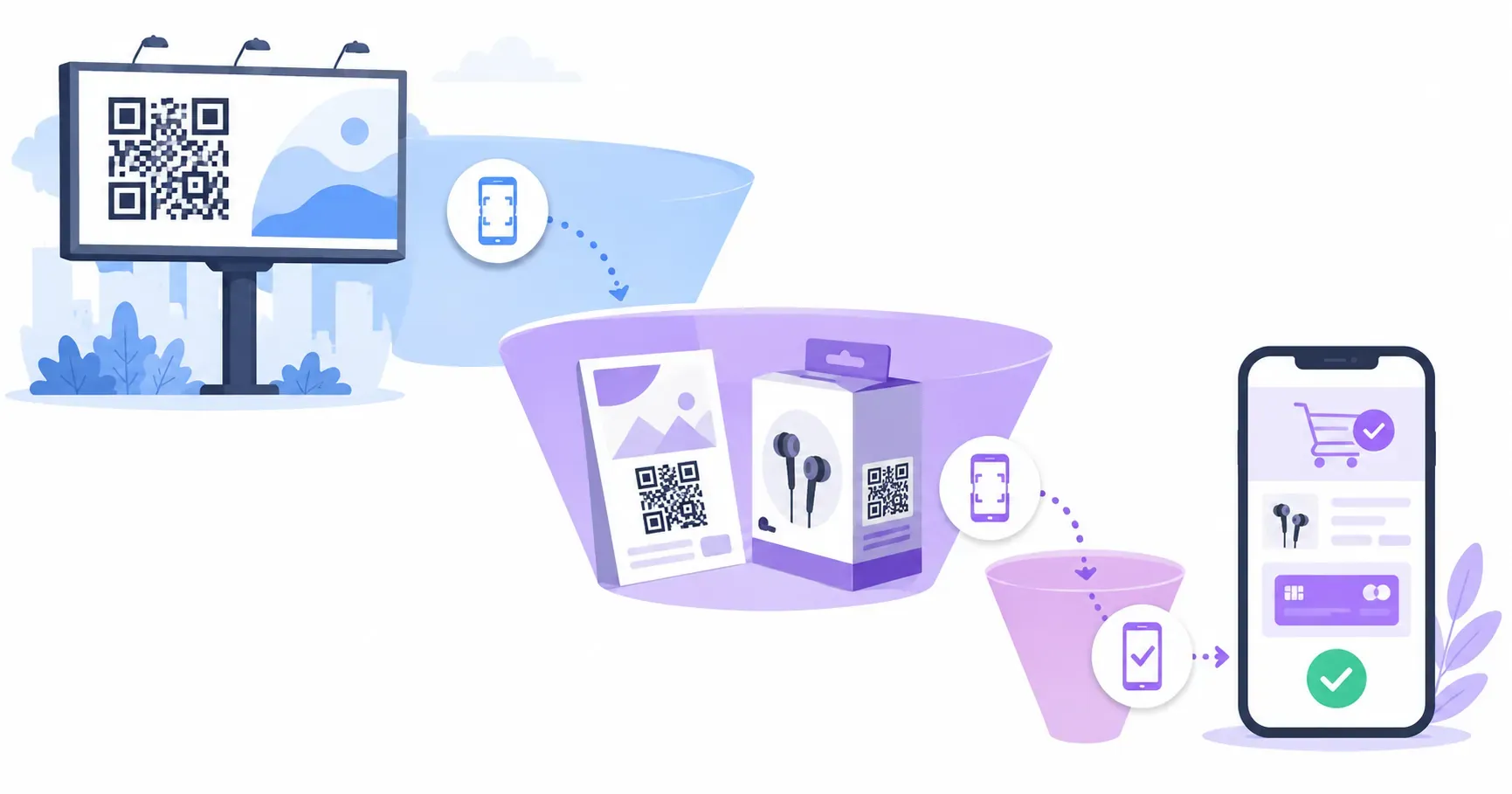
A billboard on a highway can’t take a click. A cereal box can’t run a retargeting pixel. A magazine ad can’t measure whether anyone acted on it. For decades, that gap between physical media and digital response was just accepted. QR code marketing closes it — a scan turns a poster, package, or postcard into the first tap of a measurable digital journey. But the codes themselves are the easy part. The strategy behind them decides whether you get a 0.2% scan rate or a campaign that actually moves revenue. This guide is a strategist’s framework, not a button-clicking tutorial: the campaign archetypes worth running, the placement rules that determine your scan rate, how to measure results, and the mistakes that quietly sink most attempts.
Why QR Code Marketing Works in 2026
Scanning stopped being a novelty years ago. When restaurants moved menus to codes during the pandemic, an entire population learned the gesture — point the camera, tap the banner. That muscle memory never went away. Today the camera app on every modern iPhone and Android reads codes natively, with no separate app to download, which was the single biggest barrier a decade ago.
The numbers reflect the habit. Adoption research from Bluebite and Statista has tracked steady year-over-year growth in U.S. scan volume since 2020, spanning every age group rather than just younger users. For the full dataset — market size, scan counts, and industry breakdowns — see our roundup of QR code statistics for 2026; this guide keeps the numbers light and focuses on decisions.
Here’s the strategic point that matters. A QR code is the only marketing element that lets a printed, physical, offline touchpoint become an interactive, trackable, online one in a single motion. That print-to-digital bridge is what makes the humble code a genuine strategy lever, not just a tactic.
Key takeaway: The code is a doorway, not the destination. Your strategy lives in what waits on the other side and why anyone would bother walking through it.
The Value Exchange: Give People a Reason to Scan
Nobody scans a code to help your marketing department. They scan because they expect something back. That is the entire strategic spine of QR code marketing, and most failed campaigns ignore it: they print a code that essentially says “scan to visit our website,” which is a chore, not an offer.
Frame every code as a trade. The customer spends three seconds and a bit of curiosity; you owe them a clear payoff. The stronger and more immediate the payoff, the higher the scan rate.
| Weak reason to scan | Strong value exchange |
|---|---|
| ”Visit our website" | "Scan for 20% off your first order" |
| "Learn more" | "Watch the 60-second how-it-works video" |
| "Follow us" | "Unlock the recipe on the back of this box" |
| "Download our app" | "Skip the line — order ahead here” |
Notice the pattern: strong payoffs are specific, instant, and mobile-native. A discount, exclusive content, a shortcut, a chance to win, or genuine convenience. Every campaign type below names its payoff, because a campaign without one is just a printed URL nobody asked for.
Six QR Code Marketing Campaign Types
There isn’t one way to run marketing with QR codes — there are distinct archetypes, each with its own payoff, its own natural QR type, and its own success metric. Pick the ones that match your channel and goal rather than copying whichever you saw last.
Print-to-Digital (Flyers, Posters, Brochures)
A yoga studio prints 500 flyers with a code that opens a “first class free” booking page. The payoff is the free class; the QR type is a URL code pointing to the booking form; the success metric is bookings per 100 flyers. This is the workhorse of offline-to-online marketing — cheap to test, easy to measure, and forgiving of small print runs.
Packaging and Product Experiences
A hot-sauce brand puts a code on the label that opens recipe videos and a reorder page. The payoff is content plus convenience; the QR type is a URL to a mobile landing page; the success metric is scan-to-reorder rate. Packaging codes reach customers at the moment of use, when engagement and intent are naturally high.
Out-of-Home and Signage
A gym advertises on a bus shelter with “Scan for a 7-day pass.” The payoff is the trial; the QR type is a URL code sized for distance; the success metric is passes claimed per location. Out-of-home (OOH) — billboards, transit panels, window posters — is where QR code advertising shines, because a scannable code is the only way to make a static poster interactive.
Direct Mail Response Boosters
A dentist’s postcard carries a code to book a cleaning in two taps. The payoff is a frictionless appointment; the QR type is a URL to a booking page; the success metric is response rate versus a no-code control. Adding a scannable response path consistently lifts direct-mail conversion because it removes the “I’ll call later” delay that kills follow-through.
Event and Experiential Campaigns
A conference badge holds a code that opens the session schedule and a lead form. The payoff is instant access; the QR type is a URL (or vCard for networking); the success metric is scans per attendee. Events are scan-dense environments — people expect to use their phones — so codes on badges, booths, and signage feel natural.
Loyalty and Repeat-Purchase Loops
A coffee shop prints a code on the cup sleeve that enrolls customers in a rewards program. The payoff is future free coffee; the QR type is a URL to a signup page; the success metric is repeat-purchase rate among enrollees. Loyalty codes turn a one-time sale into a relationship, and they ride along on packaging you’re already printing.
Placement Rules That Decide Your Scan Rate
Two identical campaigns with identical offers can perform ten times apart, and the difference is usually placement. A code the eye can’t reach or the camera can’t read earns zero scans no matter how good the offer is.
- Put it where a phone can reach it. Eye-level or in-hand beats a code near the floor or above a doorway. If someone can’t hold their camera 20–30 cm from the code comfortably, they won’t.
- Size it for viewing distance. Follow the 10:1 rule — the scanning distance should be no more than 10 times the code’s width. A code read from 5 meters away needs to be about 50 cm wide. For hand-held print, keep it at least 2 cm (0.8 inches) per side. Our QR code design guide covers sizing and contrast in depth.
- Label the payoff within a word or two of the code. A code with no call to action is a locked door with no sign. Print “Scan for 20% off” right beside it.
- Never place codes on moving vehicles or behind glare. A bus in motion or a sun-struck window makes a code unscannable — a surprisingly common and costly mistake.
- Guarantee the quiet zone. Keep clear space around the code equal to at least four modules so the camera can isolate the pattern from busy backgrounds.
Have your offer and landing page? Generate campaign codes free — one per channel. — Create Your Free QR Code
Measuring QR Campaigns: The Short Version
You can’t improve what you don’t measure, and the good news is that measuring QR code marketing costs nothing when you set it up right. The core move: tag every destination URL with UTM parameters before you generate the code.
A UTM-tagged link tells your analytics exactly where a visitor came from. A destination like yoursite.com/offer?utm_source=poster&utm_medium=qr&utm_campaign=spring makes every scan show up in Google Analytics as attributable traffic — no scanner app, no subscription, no special code type. Generate that tagged link as a free static code with QRocket, and ordinary web analytics become scan reporting.
Dynamic codes add a second layer: because they route through a redirect server, they log scan counts, coarse location, device type, and timestamps even before the page loads. That extra detail costs a subscription and ties the code to a service that must stay live. For the complete walkthrough — building tagged URLs, reading them in GA4, and the one-code-per-placement trick — see our guide on how to track QR code scans. This section is the summary; that article is the manual.
QR Code Marketing Mistakes to Avoid
Most underperforming campaigns fail for the same short list of reasons. Each one has a one-line fix.
- No call to action. A bare code asks nothing. Fix: add a benefit-led label right next to it.
- Desktop-only landing pages. Scans are 100% mobile, so a slow or unresponsive page loses everyone. Fix: test the destination on a phone before launch.
- Dead or wrong links. A 404 or a link pointing to last year’s promo wastes the whole print run. Fix: scan the printed proof yourself before mass production.
- Low contrast. A pale code on a busy photo won’t scan. Fix: keep dark modules on a light background with a 4:1 minimum contrast ratio.
- Code crammed into a corner. Tiny codes in ad margins get ignored. Fix: give the code visual weight and its own space.
- No test scan. Assuming it works is how thousands of unscannable posters ship. Fix: test on at least one iPhone and one Android.
- No measurement plan. A code with no UTM tag can’t prove ROI. Fix: tag the URL before generating the code, always.
Key takeaway: Every mistake here is invisible at the design stage and obvious after the print run. One test scan of the final proof catches most of them.
A 5-Step QR Code Marketing Launch Plan
Strategy becomes real when it fits on a single page. Here’s the sequence that turns an idea into a measurable QR code marketing campaign, in order.
- Set one goal. Bookings, signups, sales, or app installs — pick a single primary metric so you can tell whether the campaign worked.
- Design the offer. Decide the value exchange. What does the scanner get, and why now? Write the benefit as the code’s label.
- Choose placement and channel. Match the campaign archetype to where your audience already looks — packaging, OOH, mail, or event — and size the code for that distance.
- Build the code with a UTM tag. Tag the destination URL, then generate the code. A free static code with a stable, tagged link handles most campaigns; reach for dynamic only if the destination must change mid-flight.
- Measure and iterate. Read scans in analytics weekly, compare placements, and shift budget toward what earns scans. Then refine the offer and run it again.
Run this loop on one small campaign before scaling. A single QRocket code, one UTM tag, and a real offer teach you more than any benchmark report. Most campaigns run fine on free static codes from a free QR code generator when the landing page URL holds steady, so tool choice rarely blocks a good idea.
From Poster to Purchase, on Purpose
The teams that win with QR codes treat the square as the least interesting part of the plan. What they obsess over is the offer, the placement, and the page waiting on the other side — because that’s where scans turn into customers. If you take one idea from this guide, make it the value exchange: give people a concrete reason to lift their phone, and the scan rate takes care of itself. Run the 5-step plan on a single small campaign — a QRocket code, a UTM tag, and an offer worth acting on — and let the real numbers, not a benchmark chart, tell you what to do next. For local operators looking for lower-stakes places to start, our guide on QR codes for small business is a good companion.
Frequently Asked Questions
Is QR code marketing still effective in 2026?
Yes. Scanning is now a habit across age groups, and native camera support removed the old app-download barrier. Print-to-digital campaigns that pair a clear offer with a mobile-ready landing page consistently outperform print-only equivalents, because they turn a passive impression into a measurable action.
How do I measure QR code marketing performance?
Tag every destination URL with UTM parameters before generating the code, so each scan appears as attributable traffic in your analytics. That is free and works with any static code. Add dynamic codes only when you need scanner-level detail like device type or coarse location, which requires a subscription.
What makes people actually scan a marketing QR code?
A visible, immediate payoff. State exactly what the scanner gets — “Scan for 20% off,” “Watch the how-to,” “Skip the line” — right next to the code, and deliver it on a page that loads fast on mobile. Vague prompts like “learn more” earn far fewer scans.
What’s the biggest QR code marketing mistake?
Publishing a code with no call to action or a destination that isn’t mobile-ready. Both kill conversion before it starts: one gives people no reason to scan, the other frustrates the ones who do. A single test scan of the printed proof on a phone catches most launch-day failures.
Do I need paid dynamic codes for campaigns?
Only when your destination must change after printing, or when you need scanner-level analytics the redirect server captures. For stable offers, free static codes carry UTM tags and report scans through your normal analytics at zero cost. Start static, and upgrade to dynamic only if a real need appears.
Create a free QR code with custom colors, your logo and print-ready downloads — no sign-up.