How to Create a WiFi QR Code (Connect Without Typing Passwords)
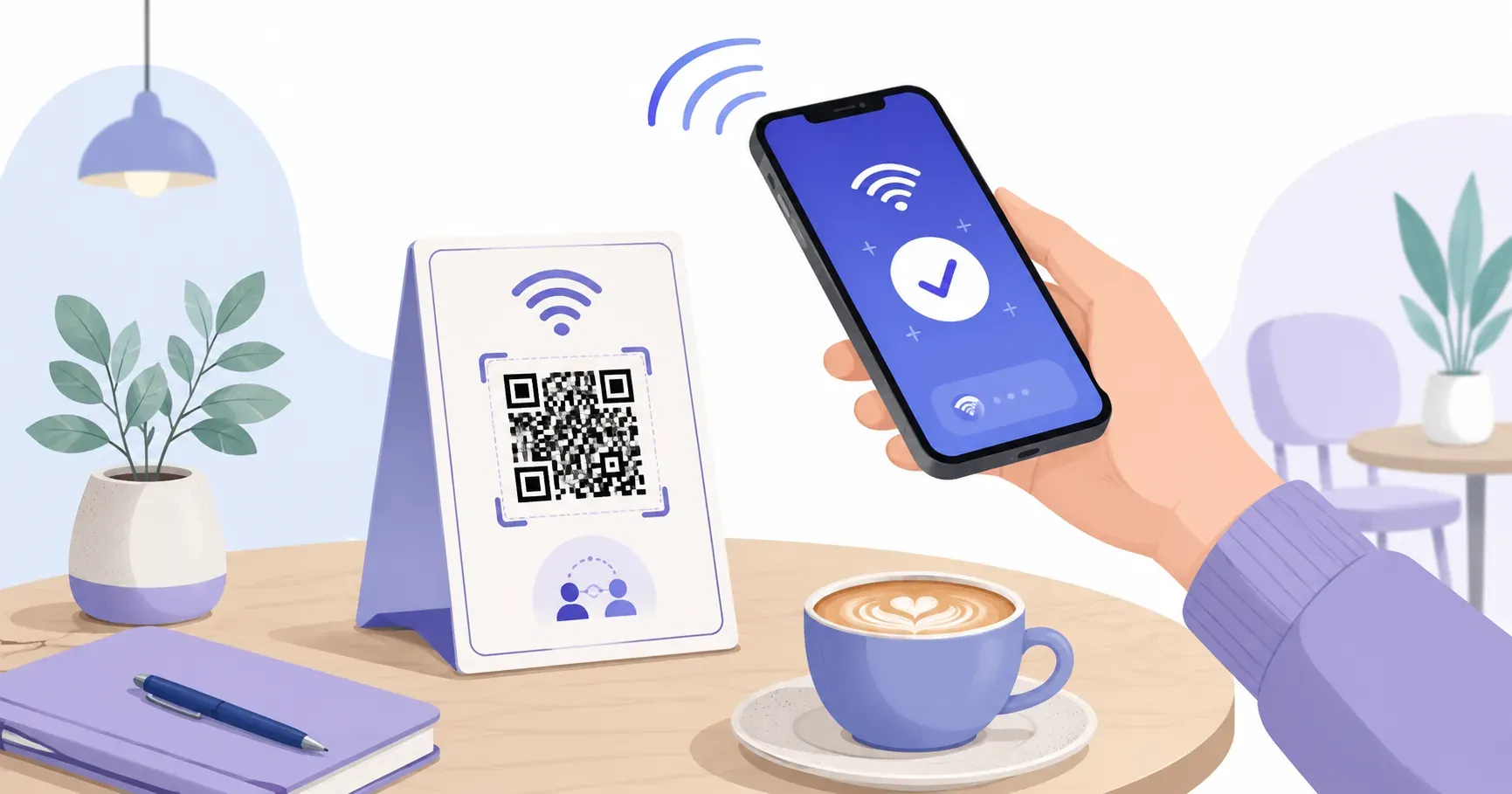
Your friend arrives, asks for the WiFi password, and you’re already spelling out “capital-B-lowercase-x-seven-hash-dollar-sign” while they squint at their phone keyboard. A WiFi QR code eliminates that entire ritual. One scan from any smartphone camera and the device connects automatically — no typing, no mistakes, no repeating yourself three times. QRocket lets you generate one in under 60 seconds, completely free. In this guide, you’ll learn exactly how to create a WiFi QR code, where to display it, and how to avoid the handful of issues that trip people up. Whether you’re setting this up for your home or your business, the process takes three fields and one click.
What Is a WiFi QR Code?
A standard QR code stores data — a URL, contact info, plain text. A WiFi QR code stores three specific pieces of information your phone needs to join a network:
- SSID — the network name (e.g., “HomeNetwork_5G”)
- Password — the exact passphrase, case-sensitive
- Encryption type — WPA/WPA2, WPA3, WEP, or None
When someone scans the code, their phone reads this data and triggers a connection prompt. The user taps “Join” or “Connect,” and they’re online. No keyboard involved.
This works because smartphones treat WiFi QR codes as a recognized data format. iPhones running iOS 11 or later and Android devices running version 10 or later handle it natively through the built-in camera app. There’s nothing to install, no third-party scanner needed.
Key takeaway: A WiFi QR code is just your network name, password, and encryption type encoded into a scannable image. The phone does the rest.
The format looks like this under the hood: WIFI:T:WPA;S:YourNetwork;P:YourPassword;; — but you never need to write that yourself. A QR code for wifi generator handles the encoding automatically.
How to Create a WiFi QR Code in 4 Steps
Here’s how to create a WiFi QR code using QRocket’s free QR generator. The whole process takes about 30 seconds once you know your network details.
Step 1: Select WiFi as the QR Code Type
Open the generator and choose “WiFi” from the type options. This loads the three fields specific to wireless network codes instead of the default URL input.
Step 2: Enter Your Network Name (SSID)
Type your network name exactly as it appears in your router settings. This is case-sensitive — “MyWiFi” and “mywifi” are different networks. Check your router’s admin panel or the sticker on the back of your router if you’re unsure.
One common mistake: using the 2.4 GHz name when your guests’ devices default to 5 GHz, or vice versa. Pick whichever band you want visitors to use. If your router broadcasts both under the same name, either one works.
Step 3: Enter the Password and Choose Encryption
Type the password exactly. Special characters like !, @, and # are fine — the QR encoding handles them. For the encryption dropdown, select WPA/WPA2 unless you specifically know your router uses WPA3. Most routers sold in the last decade use WPA2.
| Encryption Type | When to Use It |
|---|---|
| WPA/WPA2 | Most home and business routers (recommended) |
| WPA3 | Newer routers with explicit WPA3 support |
| WEP | Legacy devices only — not secure |
| None | Open networks with no password |
Step 4: Download Your QR Code
Click generate, then download the image as PNG for printing or SVG for scalable use. PNG works well for most situations — a 300 DPI image at 2 x 2 inches (about 600 x 600 pixels) gives sharp results on paper.
Create your free WiFi QR code with QRocket — guests connect in one scan — Create Your Free QR Code
WiFi QR Code for Your Home
Picture this: Thanksgiving dinner, eight relatives, and every single one needs the WiFi password. A printed QR code on the fridge handles all of them without interrupting the cook.
Guest network first. Before you share wifi password via QR code, set up a dedicated guest network on your router. Most modern routers support this in their admin panel. A guest network keeps visitors off your primary network, which means they can’t see your shared drives, smart home devices, or security cameras. Use a simple, memorable name like “GuestWiFi_Smith.”
Here are a few home scenarios where a WiFi QR code saves real time:
- Airbnb or vacation rental — Print the code on a welcome card. Guests arrive, scan, connect. No back-and-forth texts about passwords. Some hosts frame it on the nightstand next to check-in instructions.
- Home office — If clients or contractors visit, a framed code in your workspace means one less thing to manage during meetings.
- Kids’ friends visiting — Tape a small code inside a kitchen cabinet or near the router. Parents appreciate not having to ask.
A 1.5 x 1.5 inch (roughly 4 x 4 cm) printed code works at scanning distances up to about 12 inches — plenty for someone holding their phone near a fridge magnet or welcome card.
WiFi QR Code for Your Business
A cafe in Portland prints a WiFi QR code on every table tent. No more customers lining up at the counter to ask the password. No more staff writing “CafeWiFi2024!” on napkins. One code, zero friction.
Businesses benefit from a QR code for wifi access in ways that go beyond convenience:
- Cafes and restaurants — Print the code on receipts, table tents, or menu holders. If you’re already exploring QR codes for restaurants, adding WiFi access is a natural extension.
- Hotels and B&Bs — Place codes on room key cards, nightstand cards, or the welcome folder. Guests expect instant connectivity — a QR code delivers it without a front-desk call.
- Coworking spaces — Different networks for different membership tiers? Print separate QR codes for each. Members scan the one matching their plan.
- Retail stores — Offering in-store WiFi? A code at the entrance or near the fitting rooms encourages customers to browse your app or website while shopping.
Security tip: Always use a dedicated guest or public network for customer-facing WiFi. Your point-of-sale system, inventory database, and internal tools should sit on a separate, non-shared network. This isn’t optional — it’s basic network security.
Change the guest password quarterly and reprint the QR code. It takes 60 seconds with a wifi QR code generator and prevents former employees or old visitors from staying connected.
Printing and Displaying Your WiFi QR Code
Size matters more than you’d expect. A QR code that looks fine on your laptop screen might fail as a tiny printout.
Here are tested guidelines for print sizing based on scanning distance:
| Scanning Distance | Minimum QR Code Size |
|---|---|
| 6 inches (15 cm) | 0.8 x 0.8 inches (2 x 2 cm) |
| 12 inches (30 cm) | 1.5 x 1.5 inches (4 x 4 cm) |
| 3 feet (1 m) | 3.5 x 3.5 inches (9 x 9 cm) |
| 6 feet (2 m) | 7 x 7 inches (18 x 18 cm) |
Placement ideas that actually work:
- Laminated card next to the router or at the entrance
- Framed print on a hotel nightstand or Airbnb welcome table
- Sticker on the inside of a menu or table tent
- Wall-mounted sign in a coworking space lobby
Add a short label above or below the code: “Scan to connect to WiFi” with the network name visible. Not everyone knows what a QR code does on sight — a label removes the guesswork.
Use a white background with at least 4 modules of quiet zone (the blank border around the code). Dark foreground on a light background scans most reliably. Avoid printing on textured or glossy surfaces that cause glare under overhead lighting. For sizing across every distance and use case, our QR code size guide has the full reference.
Troubleshooting WiFi QR Codes
Most WiFi QR codes work on the first scan. When they don’t, it’s almost always one of these four issues.
The Password Has a Typo
QR codes store exactly what you type. One wrong character — a missing capital letter, an extra space at the end — and the connection fails silently. Double-check the password against your router settings, not from memory.
The Network Is Hidden
If your SSID is set to “hidden” in your router’s admin panel, some phones won’t auto-connect even with a valid QR code. Either unhide the network or manually connect once and let the phone remember it. For guest networks, hidden SSIDs create more problems than they solve.
Special Characters Break the Encoding
Passwords with semicolons (;), colons (:), or backslashes (\) can interfere with the WiFi QR format because those characters are delimiters in the encoding string. If your password contains them, try changing it to use other special characters like !, @, or # instead.
The Phone OS Is Too Old
iPhones need iOS 11 (released 2017) and Android phones need version 10 (released 2019) to scan WiFi QR codes natively. Older devices may need a third-party QR scanner app. If you’re learning about QR codes in general, our guide on how to create a QR code for free covers compatibility in more detail.
Frequently Asked Questions
Is sharing my WiFi password via QR code safe?
Yes, as long as you share a guest network rather than your primary one. The QR code contains the same information you’d give someone verbally — network name, password, and encryption type. A guest network adds a layer of separation that protects your personal devices and files.
Do WiFi QR codes work on both iPhone and Android?
Both platforms support WiFi QR code scanning natively. iPhones need iOS 11 or later (2017+), and Android devices need version 10 or later (2019+). Just open the camera app, point at the code, and tap the connection prompt that appears.
Does the QR code stop working if I change my WiFi password?
Yes. The password is encoded directly into the QR image, so changing your WiFi password makes the old code useless. Generate a new code with the updated password and replace any printed copies. This takes under a minute with any free generator.
What encryption type should I choose?
Choose WPA/WPA2 for the vast majority of routers. WPA2 has been the default standard since roughly 2006 and covers nearly all home and business setups. Only select WPA3 if your router’s admin panel explicitly shows WPA3 as the active security mode.
Can a WiFi QR code work for a hidden network?
Yes. Enable the hidden-network option when you generate the code so the phone knows to search for an SSID that isn’t broadcast. Without that flag, some devices ignore a valid code because they never see the network advertised. For guest access, an unhidden network usually scans more smoothly.
A Password You Never Have to Say Out Loud
The best WiFi password is one nobody ever needs to type. A single QR code replaces every awkward spelling-out-loud moment, every napkin note, every “is that a zero or the letter O?” conversation. Print one, stick it where guests can see it, and you’ll never dictate a 16-character passphrase again. Ready to make yours? Create a free WiFi QR code with QRocket and have it printed in under two minutes.
Create a free QR code with custom colors, your logo and print-ready downloads — no sign-up.